The Rule Everything Obeys
One sentence. Followed to its logical end. The entire universe.
in all inertial frames."
In other words: it doesn't matter where you are, how fast you're moving, or which direction you're facing. The same rules apply. No special place. No special direction. No background. Just the rules.
What Would Breaking This Rule Look Like?
Try adding structure to the universe. Watch the symmetry break.
The grid is symmetric — every point is equivalent to every other. This is what the postulate demands.
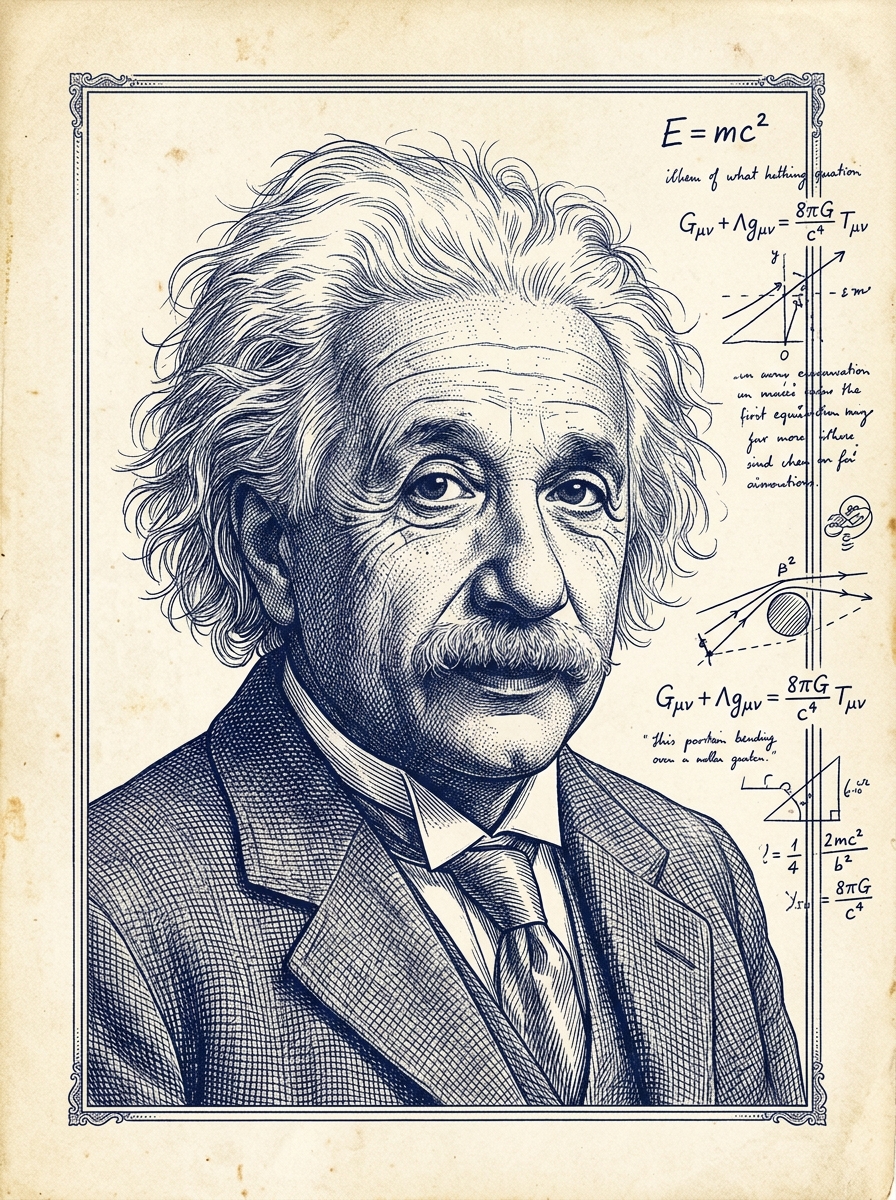
The supreme task of the physicist is to arrive at those universal elementary laws from which the cosmos can be built up by pure deduction.
It appeared impossible to prove κ > 0 from the relativity principle alone.
This paper supplies the missing proof Pauli said couldn't exist. The postulate's own language — velocity is displacement per unit time — requires a distinguished time direction, which forces κ > 0.
The Postulate Has Four Consequences
Each is not an assumption — it is a logical necessity. Violating any one requires a preferred structure the postulate forbids.
Linearity
A displaced inertial frame must also be inertial. If it weren't, there would be a preferred origin — a special point in space. The postulate forbids special points.
Group Composition
If moving from A to B is a valid transformation, and B to C is valid, then A to C must also be valid. The set of all valid moves forms a mathematical group.
Isotropy
A rotated inertial frame is still inertial. If some orientations were non-inertial, there would be a preferred direction in space — forbidden by the postulate.
Reciprocity
If you see me moving at speed v, I see you moving at speed −v. Anything else would make one frame special over another — which the postulate cannot allow.