The Algebra
Ten generators. Two unknown parameters. The mathematical machinery the postulate builds — and how it fixes everything.
What Is a Lie Algebra?
In Plain English
A Lie algebra is the mathematical language of symmetry. When you describe all the ways you can move, rotate, or boost between frames, those transformations form a Lie group. The Lie algebra is the infinitesimal version — the "directions" you can move in. The postulate constrains what these directions can be.
Technically Speaking
The linearity, isotropy, and reciprocity of inertial frame transformations guarantee a Lie group (by Cartan's closed subgroup theorem). Its Lie algebra has N(N−1)/2 rotation generators, N boost generators, and N+1 translation generators. Isotropy constrains the brackets to two free parameters: κ and Λ.
The Ten Generators of so(4,1)
Three rotations · Three boosts · One time translation · Three space translations
The Complete Algebra
Each row is a "commutation relation" — it says what happens when you apply two generators in succession.
The Killing Form Fixes Everything
The Killing form B(X, Y) is the algebra's own canonical measure of how generators mix under commutators. It is not imposed from outside — it is derived from the structure constants themselves. And it turns out to be decisive.
Rotations are compact — they close back on themselves
Boosts are non-compact when κ > 0 — they can go on forever
Time translations are non-compact when Λ > 0
Space translations are compact relative to time
Why κ must be positive
If κ = 0: The Killing form cannot "see" the boosts — B(K,K) = 0. You need an external speed scale. That's forbidden external structure.
If κ < 0: The group SO(4) acts transitively on all directions; no direction is distinguished as timelike. But velocity is displacement per unit time — requiring a distinguished time direction. Velocity is undefined when κ < 0. Therefore κ > 0. This gives us V = 1/√κ — the speed of light. As a derived result.
Why Λ must be positive
If Λ = 0: Translations commute and the Killing form can't see them. An external metric is needed. Forbidden.
If Λ < 0: B(P₀,P₀) = 6Λ < 0, making time translation compact-type — same kind as rotations. Time translations and rotations become structurally equivalent. The spacetime (anti-de Sitter) has a timelike boundary requiring boundary conditions not fixed by the postulate. Forbidden.
Therefore Λ > 0. The cosmological constant — Einstein's "greatest blunder" — is positive. This was confirmed by Riess et al. in 1998. The algebra knew it first.
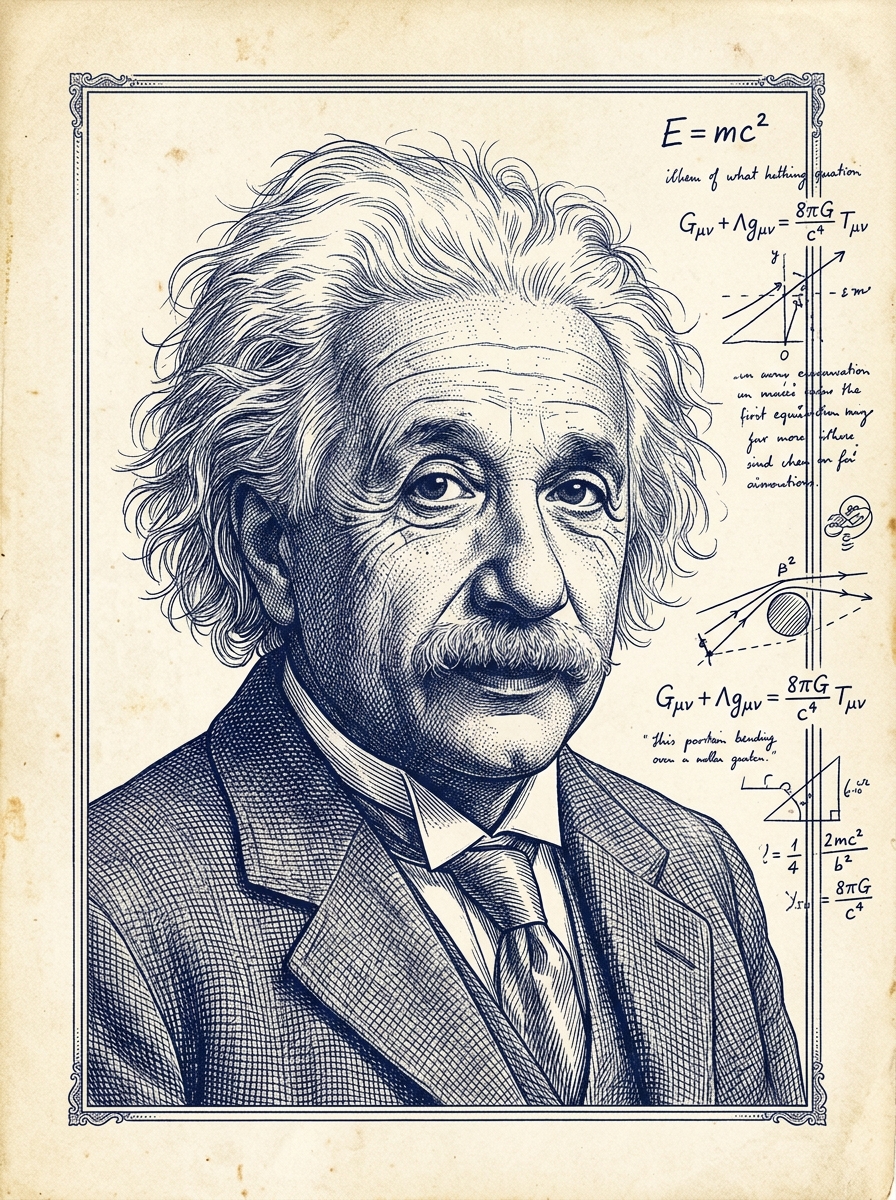
The greatest blunder of my life.
Einstein introduced the cosmological constant Λ in 1917, then withdrew it after Hubble's discovery of the expanding universe. He called it a blunder. But Riess et al. (1998) showed Λ > 0 — confirmed. And this paper shows Λ > 0 follows necessarily from the relativity principle. It was never a blunder.
Emmy Noether and the Algebra
Once the de Sitter algebra so(4,1) is established and its Killing form placed on a curved manifold, Noether's theorems are what transform algebraic structure into physics. Two distinct theorems each play a decisive role in this paper.
Symmetry → Conserved Charge
Each of the ½(N+1)(N+2) continuous symmetries of de Sitter spacetime — its Killing vectors — yields a conserved charge. In D = 4: energy, three momenta, three angular momenta, three boost charges — 10 charges total. But the translation brackets [P₀, Pᵢ] = −Λ Kᵢ entangle them all into a single multiplet of SO(4,1). The separate conservation laws of special relativity are recovered only in the Λ → 0 limit.
Gauge Symmetry → Bianchi Identity
The action's invariance under diffeomorphisms (local coordinate changes) yields not a conservation law but an algebraic identity: ∇νGμν = 0. This identity is not assumed — it is forced. It in turn requires any matter source to satisfy ∇νTμν = 0: all matter follows geodesics regardless of composition. The equivalence principle — which Einstein had to postulate — is a consequence of Noether's second theorem applied to the algebra's action.
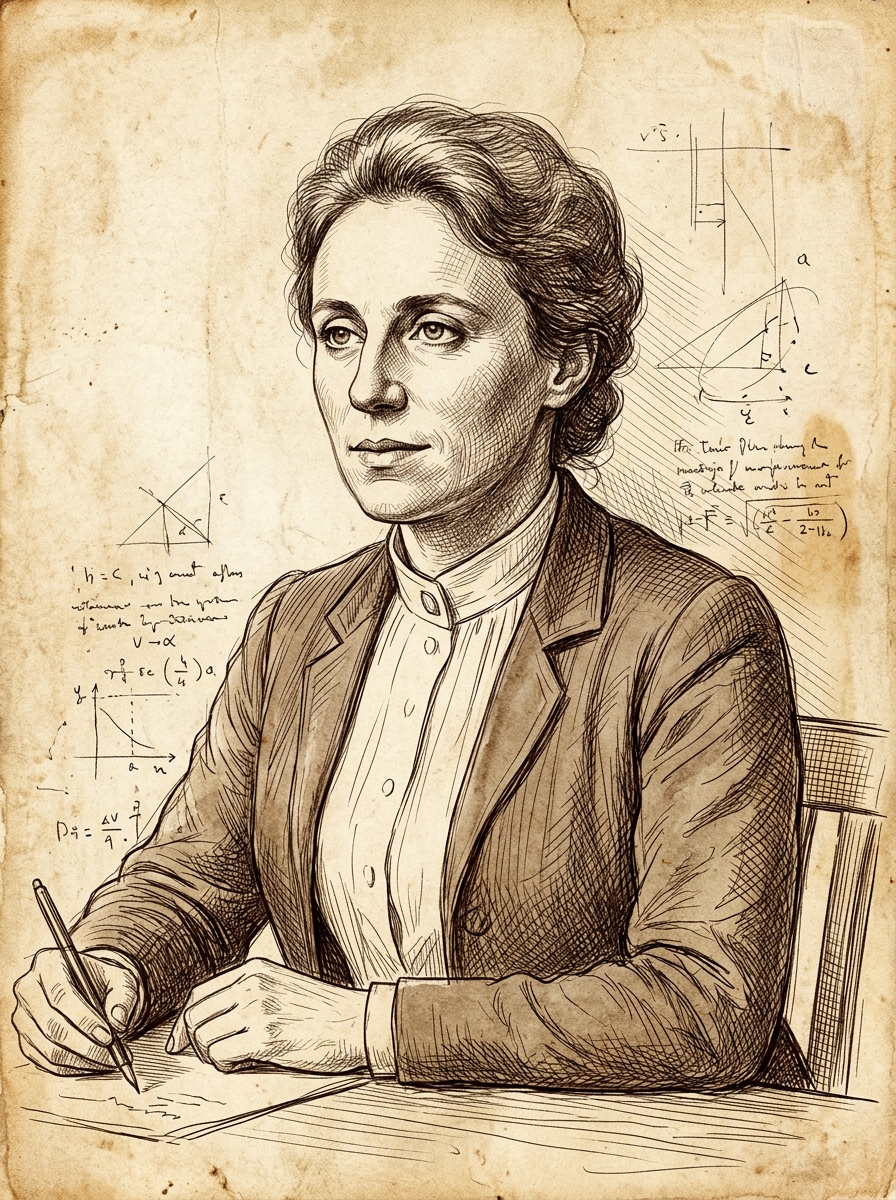
My methods are really methods of working and thinking; this is why they have crept in everywhere anonymously.
Both of Noether's theorems are essential to this paper. Her second theorem provides the Bianchi identity — forcing the equivalence principle. Her first theorem classifies the conserved charges, revealing that energy and momentum are not independently conserved in de Sitter but form a single SO(4,1) multiplet entangled through Λ.