Intelligent
Relativity
One Sentence. Everything.
Einstein needed two assumptions to build his theory of relativity. This paper shows one is enough — and from it, the entire universe follows by pure logic.
“The laws of physics are the same in all inertial frames.”
— The only postulate needed
From One Rule, Six Revelations
No additional assumptions. No extra ingredients. Just pure deduction.
4 Dimensions
The universe has exactly four spacetime dimensions. D₂ = A₁×A₁ is the unique Lorentz algebra that imposes no constraint the postulate did not generate.
Speed of Light
An invariant speed exists and is finite. Einstein stated this as a second postulate. Here κ > 0 is forced by the Killing form — the speed limit is derived.
The Equivalence Principle
All matter follows geodesics regardless of composition. Noether's second theorem applied to diffeomorphism invariance forces this — Einstein had to assume it.
E = mc²
The most famous equation in science. Mass and energy are the same thing, in the same units. The Lorentz-invariant norm of 4-momentum gives this directly.
The Expanding Universe
Space is expanding and accelerating. Λ > 0 follows from the Killing form's sign structure — Einstein's 'greatest blunder' was a structural necessity.
Conservation Laws Unified
Energy, momentum, and angular momentum are not independently conserved — they form a single 10-component SO(4,1) multiplet. Separate conservation is an artifact of the Λ → 0 limit.
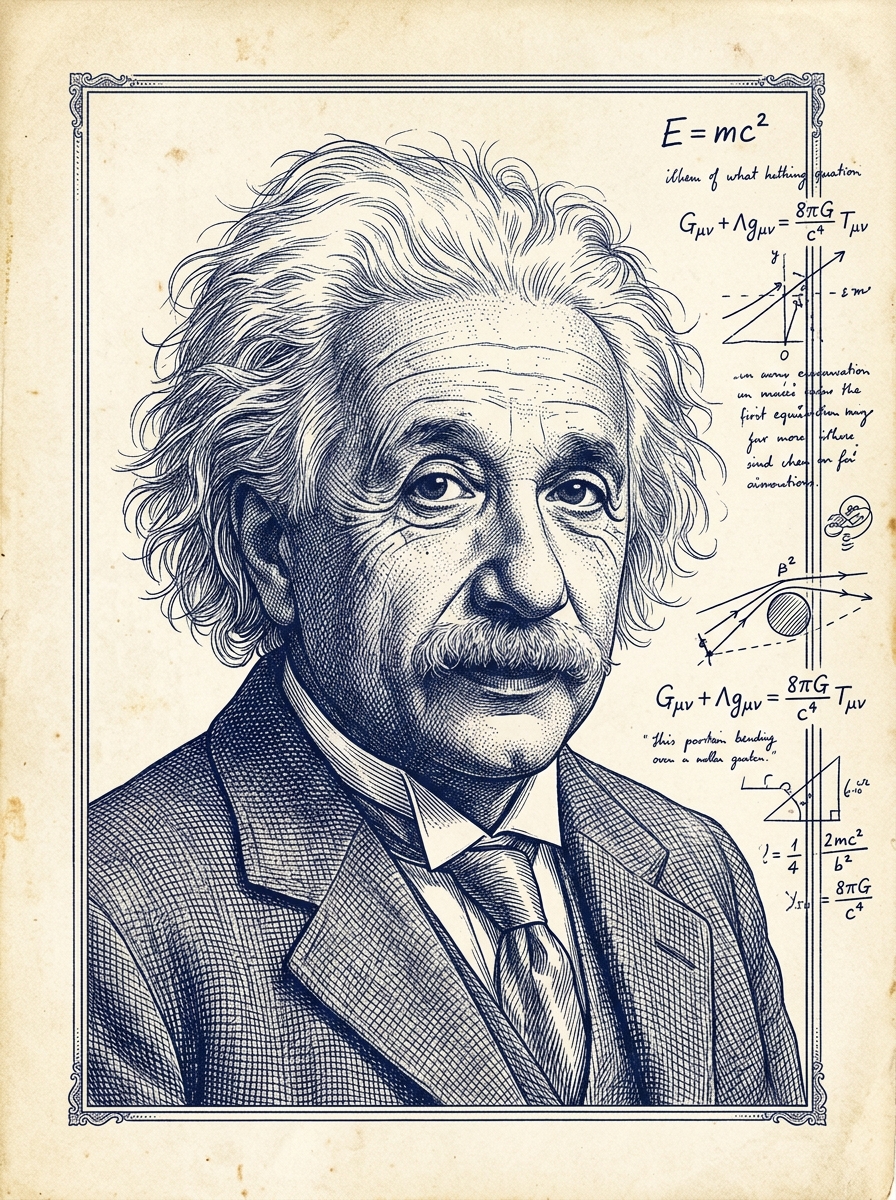
The supreme task of the physicist is to arrive at those universal elementary laws from which the cosmos can be built up by pure deduction.
Explore the Paper
Each chapter builds on the last — follow the logic, feel the wonder.
The Logical Chain
Einstein needed the equivalence principle, general covariance, and the speed of light as separate assumptions. This paper shows all three follow from one. Noether's theorems provide the bridge: her second theorem forces the equivalence principle; her first theorem unifies the conservation laws into a single SO(4,1) multiplet.
It appeared impossible to prove κ > 0 from the relativity principle alone.
This paper supplies the missing proof Pauli said couldn't exist. The postulate's own language — that boosts are parameterised by velocity — requires time to be distinct from space, which demands κ > 0.
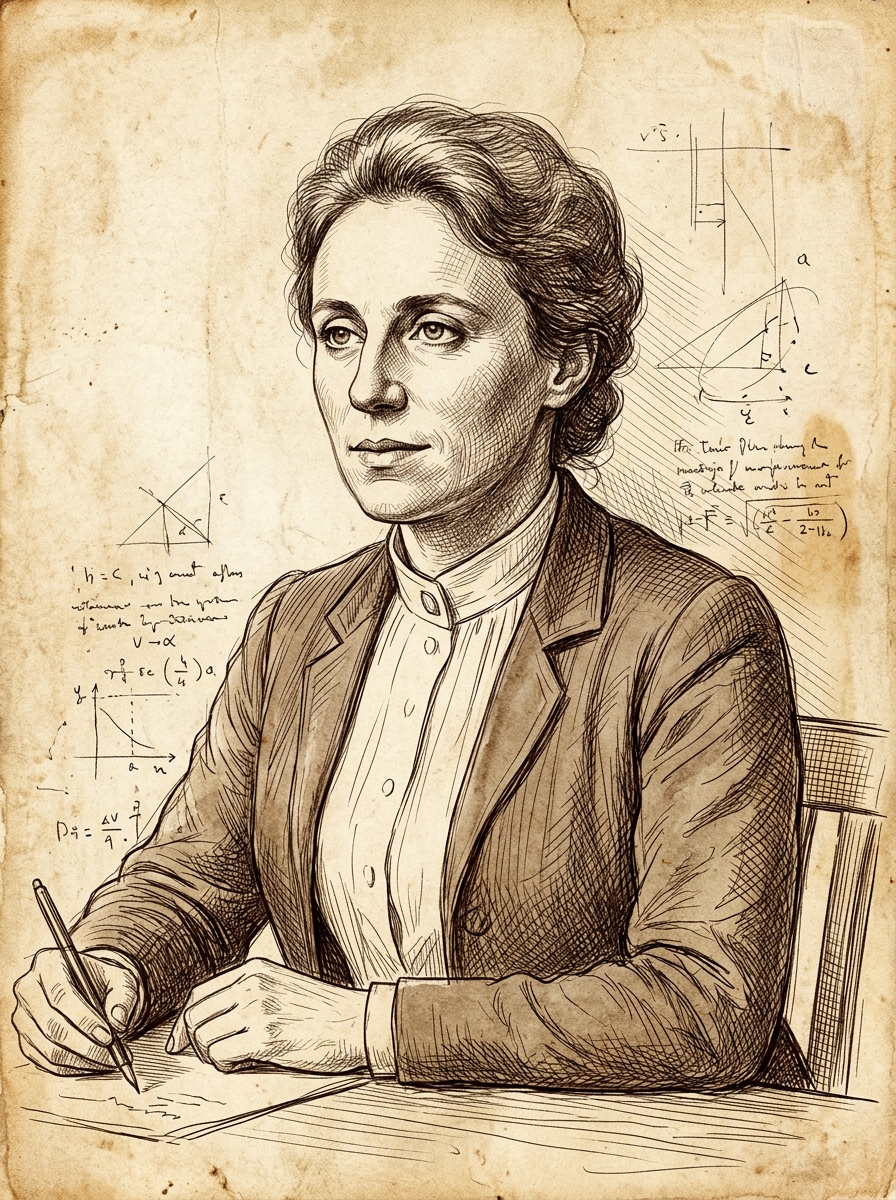
My methods are really methods of working and thinking; this is why they have crept in everywhere anonymously.
Both of Noether's theorems are essential to this paper. Her second theorem (1918) — applied to diffeomorphism invariance — forces the Bianchi identity ∇νGμν = 0, and with it the equivalence principle. Her first theorem provides the conserved charges: energy, momentum, and angular momentum unified as a single SO(4,1) multiplet.
Ready to follow the logic?
No physics background required. Every concept explained in plain English first.
Start with The One Rule